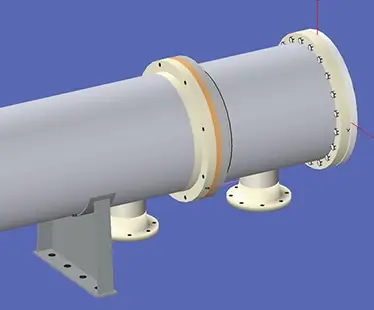
An Important Addition to ASME VIII-2: Class 1 Vessels

Beginning with the 2017 Edition of the ASME VIII-2 Code, it is now less expensive to build most medium size and larger carbon steel pressure vessels to Division 2, Class 1 instead of Division 1. Division 2 does this by introducing a new Class 1 vessel designation. Class 1 vessels use higher allowable stresses and more accurate design rules (equations) than Division 1 resulting in reduced wall thicknesses, nozzle reinforcement and welding.

A Comparison of Class 1 and Class 2 Vessels

The 2017 Edition of ASME VIII-2 now divides vessels into two classes, Class 1 and Class 2. The requirements for Class 2 vessels are largely unchanged from the previous 2015 Edition of ASME VIII-2. Class 1 vessels are new for 2017 and differ from Class 2 vessels as follows:

  • Class 1 vessels use a design margin of 3.0 instead of 2.4. However,  most common materials used at typical temperatures do not see a reduction in their allowable stress because of this change. For example, a Class 1 vessel constructed from SA-516 70 at 400 degrees F uses the same allowable stress and requires the same thickness as a Class 2 vessel. The engineering costs to design a vessel for non-cyclic service in Class 1 and Division 1 are similar so it is now less expensive to build many vessels using Class 1 instead of Division 1. Non-cyclic service typically means fewer than 1,000 pressure-temperature cycles; for more exact requirements see Section 5.2.2 for Class 1 or U-2 for Division 1.

  • For Class 1, the User’s Design Specification (UDS, received from the owner) needs to be certified by a Registered Professional Engineer only for cases where a fatigue analysis is necessary. Note that reviewing the UDS is still required.

  • For Class 1, the Manufacturer’s Design Report (MDR) needs to be certified by a Registered Professional Engineer only if Part 5 is used to design a component not covered by the equations of Part 4 or if a fatigue analysis is necessary. Note that the MDR is still a required document.

The new Class 1 vessel designation provides a way for “U” Certificate holders to build material saving Division 2 vessels without all of the additional overhead involved in producing full Class 2 vessels. For more information on obtaining an ASME Certificate of Authorization to fabricate ASME VIII-2, Class 1 vessels see Code Case 2891.  The COMPRESS Division 2 option and INSPECT have been updated to include a Class 1 vessel design option.
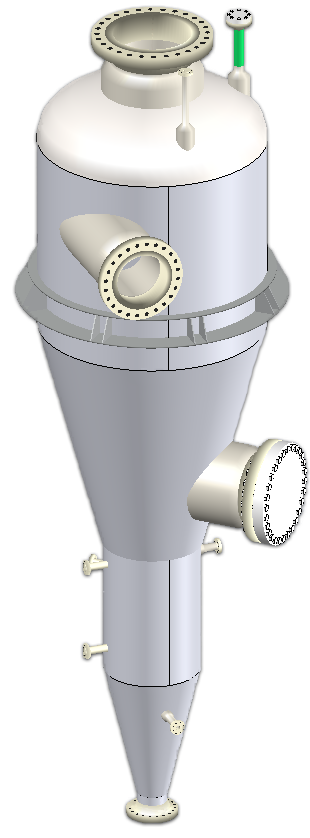
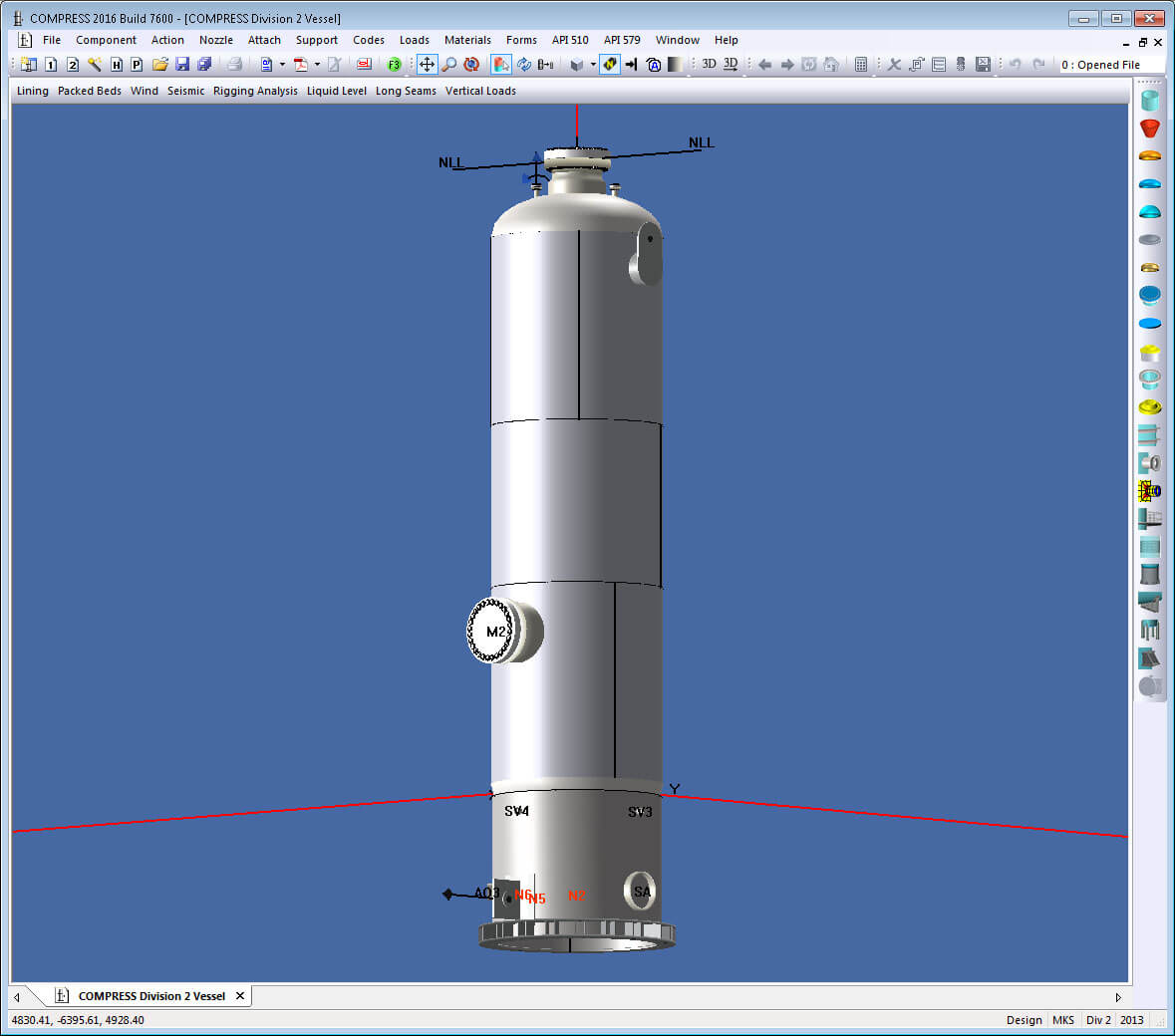
Cyclone Vessel - Division 2
A complete ASME VIII-2, (Division 2) pressure vessel in COMPRESS. The 2017 Edition of the ASME VIII-2 BPVC includes new Class 1 and Class 2 vessel designations

ASME VIII-2 Versus ASME VIII-1 Cost Considerations

The overall cost reduction between Division 1 and Division 2 depends on answering the following question. Do the material and labor savings exceed the additional engineering, quality control and administrative costs? Historically, large, thick vessels have been good candidates for Division 2. The introduction of Class 1 vessels in the 2017 Edition of Division 2 gives more flexibility when deciding which Division is more cost efficient. Cost reductions are now available in more cases including carbon steel vessels with volumes larger than around 200 gallons (800 litres) designed for temperatures below 600 degrees F (315 degrees C).  Division 2 also requires fewer reinforcing pads and allows thinner nozzle forgings resulting in additional cost savings. With the COMPRESS Division 2 Option you can switch between Divisions and Classes at any time. This makes it easy to determine which Division and Class produces the lightest, most economical vessel design.

How Does ASME VIII-2 Differ From ASME VIII-1?

One of the main differences between Divisions 1 and 2 is that Division 2 uses lower design margins often resulting in higher material allowable stresses. Design margins are reduction factors applied to the material’s ultimate tensile strength (UTS) for the purpose of setting material allowable stresses in ASME II-D. The design margins are currently 3.5 for Division 1, 3.0 for Division 2, Class 1 and 2.4 for Division 2, Class 2. In Division 1, hydrotest stresses are not specifically limited and partial penetration nozzle welds are permitted. In Division 2, hydrotest stresses are limited so hydrotest stress calculations are mandatory and full penetration nozzle welds are required.

Another major difference is the theory of failure assumed and therefore the design equations used. Specifically, Division 1 uses the maximum principle stress theory while, starting with the 2007 Edition, Division 2 uses Von Mises. As a result, Division 1 uses two sets of design equations one for “thin” and another for “thick” vessels while Division 2 uses one set of equations for all vessel thicknesses. Of particular note are the more accurate nozzle design and allowable compressive stress (external pressure) rules in Division 2 both of which can provide additional savings.

In general, thinner Division 2 vessels retain safety factors that are comparable to thicker Division 1 vessels by incorporating more extensive engineering analysis and design requirements.
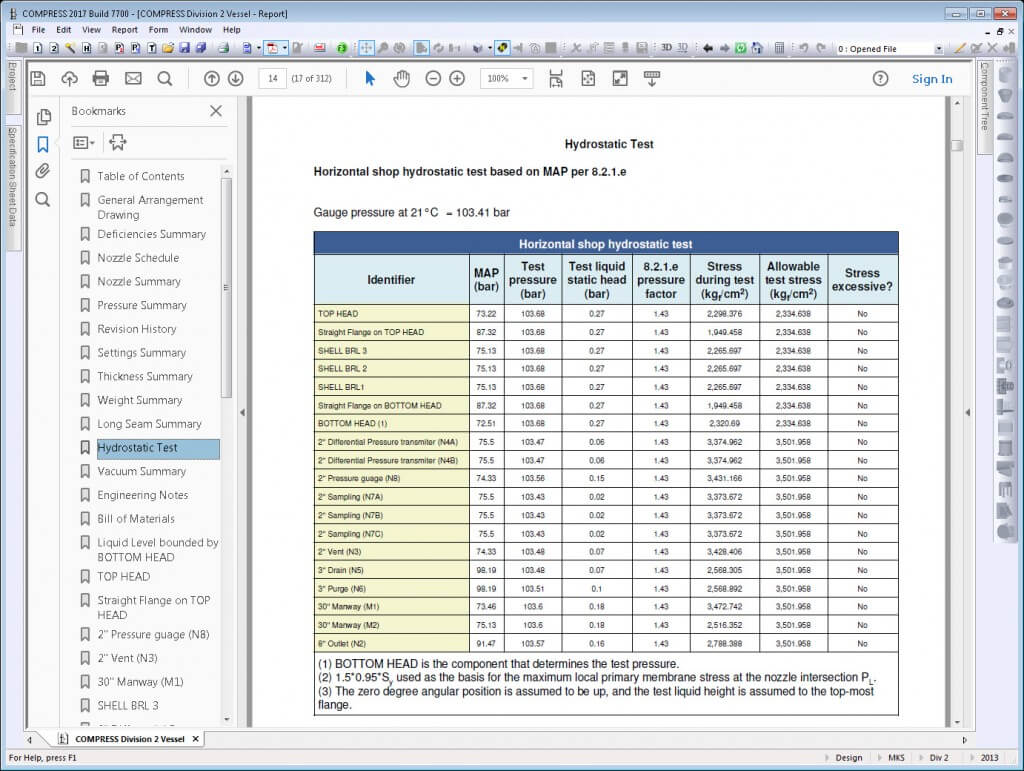
COMPRESS includes ASME VIII-2 (Division 2) hydrotest stress calculations and reports, a mandatory Division 2 requirement

Increase Your Capabilities With COMPRESS

Nozzles Simplify the detailing of nozzle attachments with flexible and intuitive nozzle design capabilities. Finite Element Analysis Built-in FEA for Nozzles, Clips and TEMA Expansion Joints. API 650 Storage Tanks Modeling storage tanks is easy as COMPRESS guides you through an intuitive design wizard. Vacuum Rings Drag-and-drop vacuum rings and quickly see how the external pressure rating changes. Quick Design Speed up the process of pressure vessel modeling with Quick Design mode. Productivity Software packages like COMPRESS exist to increase productivity and save Engineering hours. Heat Exchanger Perform ASME UHX and TEMA calculations independently or leverage the bi-directional interface with HTRI. Division II As Division 1 increasingly references Division 2 provisions, many companies are transitioning to Division 2 rules to capitalize on material savings. MDMT Rules of UCS-66 The rules of UCS-66 guard against vessel failure by brittle fracture, a low probability, high consequence event. External Pressure Design Simplify the complexity of the
UG-28 rules for external pressure design and vacuum rating.
Jacketed Vessels Design both conventional and half pipe jacketed vessels. Vessel Wizard The Vessel Wizard speeds pressure vessel design by creating complete pressure vessel models with minimal input. COSTER Import files from COMPRESS and create user customizable pressure vessel cost estimates in spreadsheet format. Flange Design Create optimized Appendix 2 flange designs with minimal time and effort and account for loadings on standard B16.5/16.47 flanges. Weld Seams Designers can visually confirm good practices such as staggered longitudinal seams. Lifting & Rigging Use an accurate weight, the correct center of gravity, and apply the actual section properties. Modeling + Drawings The Codeware Interface includes Drafter 3D, a feature that auto-generates 2D pressure vessel drawings. Related Codes COMPRESS implements a wide range of related engineering methods, codes and standards. Design Mode Save time by reducing the trial and error iterations that would otherwise be required when designing pressure vessels. Rating (Analysis) Mode The COMPRESS Rating Mode takes your design and determines the vessel’s MAWP, MAEP and MDMT. Hydrotest Performing hydrotest stress calculations in the design stage prevents equipment damage during hydrotesting. Hillside Nozzle COMPRESS saves time by calculating chord openings and governing planes of reinforcement automatically. ASME Editions Older ASME Codes are retained in all COMPRESS releases so you can always use the latest software. Automatic Liquid Levels COMPRESS eliminates the need to manually calculate each vessel component’s liquid static head. Global External Loads The Loads Menu allows designers to easily consider global external loads when sizing pressure vessel supports. Clips and Lugs Quickly add in various structural shapes to complete your design. Multi-Chamber Vessels Certain industrial processes require pressure vessels with multiple chambers operating under different design conditions. Appendix 46 Produce more economical Div 1 pressure vessel designs with increased accuracy from the Div 2 design by rule equations. Manufacturer's Data Reports Simplify the creation, submission and management of ASME Manufacturer’s Data Reports and NBIC Repair and Alteration Forms. Support Skirt Openings Specify piping connections to vertical vessels that require additional piping and openings cut out of the support skirt. Branch Connections Reduce pressure vessel welding and material costs by modeling tees in COMPRESS. Foundation Loads Summary Break down the loads for the specified vessel operating conditions including weight, wind, seismic, and vortex shedding. Shipping Saddles COMPRESS provides a shipping saddle option based on the industry standard Zick Analysis. UG-80 and UG-81 COMPRESS automatically provides out-of-roundness tolerances that must be maintained during pressure vessel fabrication. Nameplate Design Every pressure vessel is required by Code to have a nameplate. COMPRESS handles this by including a convenient nameplate option. Fatigue Screening Quickly enter fatigue data to determine if a fatigue assessment is required. WRC 537 Nozzle Loads Check stresses on nozzles using WRC 107 and WRC 537 stress analysis for spherical and cylindrical shells.
COMPRESS Quick Design Mode Heat Exchanger designed in COMPRESS Division 2 option in COMPRESS MDMT Rules of UCS-66 Bill of Materials generated from COSTER Flange design in COMPRESS Weld seam wizard in COMPRESS Lifting mechanics in COMPRESS Drafter 3D from Codeware COMPRESS includes related engineering methods, codes, and standards Design mode in COMPRESS Rating mode in COMPRESS Hydrotesting in COMPRESS Hillside Nozzle design in COMPRESS 2023 ASME VIII Code Edition in COMPRESS Automatic Liquid Levels in COMPRESS External Loads in COMPRESS Pressure Vessel clip with pad in COMPRESS Multi chamber pressure vessels in COMPRESS Appendix 46 in COMPRESS ASME Manufacturer's data reports in COMPRESS Support Skirt Openings in COMPRESS Foundation Loads Summary in COMPRESS UG-80 and UG-81 design in COMPRESS Jacketed Vessel in COMPRESS Pressure vessel nozzles Shipping Saddles in COMPRESS Nameplate design in COMPRESS WRC 537 Nozzle Loads in COMPRESS Fatigue Screening in COMPRESS Vacuum Rings in COMPRESS FEA Nozzles in COMPRESS API 650 in COMPRESS Branch Connections in COMPRESS

Request More Information

To see how COMPRESS can benefit your organization we invite you to contact us today.