INSPECT

API 579 Fitness-For-Service Software

INSPECT performs the calculations and assessments needed by Engineers engaged in process plant inspection and maintenance activities.  It creates detailed Fitness-For-Service (FFS) reports for pressure vessels, heat exchangers, piping, and above ground storage tanks.  INSPECT Fitness-For-Service Software reduces regulatory compliance risk by creating ASME design reports for your undocumented pressure vessels.  It also organizes and adds context to your inspection data by showing CML’s and API 579 flaws on its 3D equipment models.

Depending on your needs, INSPECT’s API 579 FFS can assess individual components, complete vessels, or model entire process systems.  INSPECT performs rigorous tmin calculations that can extend vessel remaining life and inspection intervals.  INSPECT’s integration with Shopfloor helps you document welding repairs as well.

INSPECT is a Fitness-For-Service extension of our market leading COMPRESS pressure vessel software.  It includes all available COMPRESS functionality and shares the same easy to use interface and file format.

INSPECT Featured API 579 FFS Software Capabilities

API 579 Part 3 Ensure your operating procedures limit the risk of brittle fracture by automatically running Part 3 assessments. API 579 Part 4 & 5 Perform general and local metal loss assessments and quickly generate detailed reports. API 579 Part 6 INSPECT performs level 1, 2 and 3 pitting assessments and generates detailed API 579 reports with a click of a button. API 579 Part 7 Perform Level 1 and 2 assessments from Hydrogen Induced Cracking (HIC) and Hydrogen Blister damage. API 579 Part 8 Ensure that vessels subject to external pressure are within the allowed roundness tolerance with out-of-roundness assessments. API 579 Part 9 Level 1 and 2 assessments quickly determine which crack-like flaws can be safely left in service and which require more investigation. API 579 Part 10 Perform creep damage assessments by recording equipment operating histories and calculations. API 579 Part 11 Perform fire damage assessments and document conclusions in a consistent series of data entries and reports. API 579 Part 12 Perform Part 12 assessments and generate detailed API 579 reports. Level 1 and 2 dent, gouge and dent-gouge combinations are available. API 579 Part 13 Model laminations and provide rapid results so you can make the necessary mediation decisions with confidence API 579 Part 14 INSPECT’s fatigue assessment scans the vessel for other flaw types and allows the user to adjust the “remaining strength factor” (RSF) as required by API 579. API 510 Address in-service activities such as inspection, remaining life determination and repair. API 570 3D inspection data management and calculations simplify compliance with the requirements of the API-570 Code. API 653 Track tank thickness inspection measurements and provide calculation reports. Gage Integration Set up and retrieve inspection grids from thickness gages fast and easy. OSHA 1910 Meet the Mechanical Integrity requirements of OSHA1910.119 (j) and EPA Title 40 part 68.73. Undocumented Vessels Pressure Vessel Inspection Code requires owners to maintain permanent, progressive records as listed in API 510 Section 7.8 The INSPECT IDMS Show condition monitoring locations (CML’s) and API 579-1 flaws directly on pressure equipment models. Auto-Refrigeration MAT curves are employed to determine which process conditions put equipment at risk of failure by brittle fracture. Old ASME® Codes Supported Increase vessel life automatically by using the higher allowable stresses per NBIC Section 3.4. Pressure Relieving Devices Easily model pressure relieving devices (PRDs) on your fixed equipment. Excel Integration Export and import thickness inspection grids to and from Microsoft Excel. API 579-1 Part 3 MAT Curves API 510 API 570 API 653 Storage Tank Evaulations Thickness Gage Integration in INSPECT OSHA standards in COMPRESS Undocumented Vessels in INSPECT Inspection Data Monitoring System IDMS API 579 Part 9 Codes menu Combined Pitting and Local Metal Loss Flaws are Considered API 579-1 Part 12 dialog INSPECT performs API 579 FFS assessments and shows flaws on the 3D model Minimum Safe Operating Temperature (MSOT) curve in INSPECT API 579-1 Part 10 Creep Damage API 579-1 Part 11 Fire Damage Assessments API 579-1 Part 8 Out of Roundness Easily model pressure relieving devices (PRDs) with INSPECT Excel Integration with INSPECT API 579-1 Part 7 Hydrogen Cracking and Blister Damage API 579-1 Part 13 Lamination Diagram API 579 Part 14 Fatigue - Pressure Fluctuation Cycle

INSPECT:  Comprehensive FFS + Mechanical Integrity Software
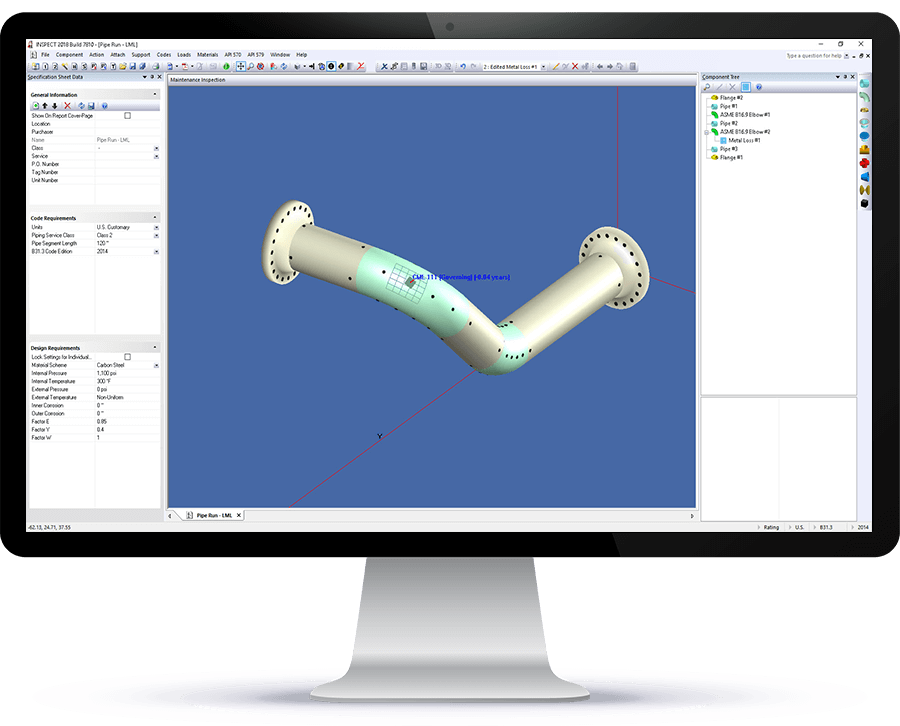
INSPECT's API 579 FFS assessments cover a wide range of equipment and flaw types

API 579 / ASME FFS

Taking equipment out of service is expensive but leaving damaged equipment in service can be risky.  INSPECT’s FFS assessments assist Engineers in determining if repair or replacement is really necessary.  A wide range of flaws are addressed including general and local metal loss, pitting corrosion, grooves, dents, gouges, cracks, creep, HIC, out-of-roundness, laminations, and fire damage.  Complete Part 3 brittle fracture checks automatically support INSPECT flaw assessments.  INSPECT’s Minimum Safe Operating Temperature curves can quickly screen process equipment that may be exposed to auto-refrigeration. INSPECT’s data logger integration can quickly turn thickness survey readings into FFS results and help ensure turn arounds stay on schedule.  INSPECT produces detailed API 579 remaining life reports that let you verify the calculations performed and provide RAGAGEP support for your recommendations.
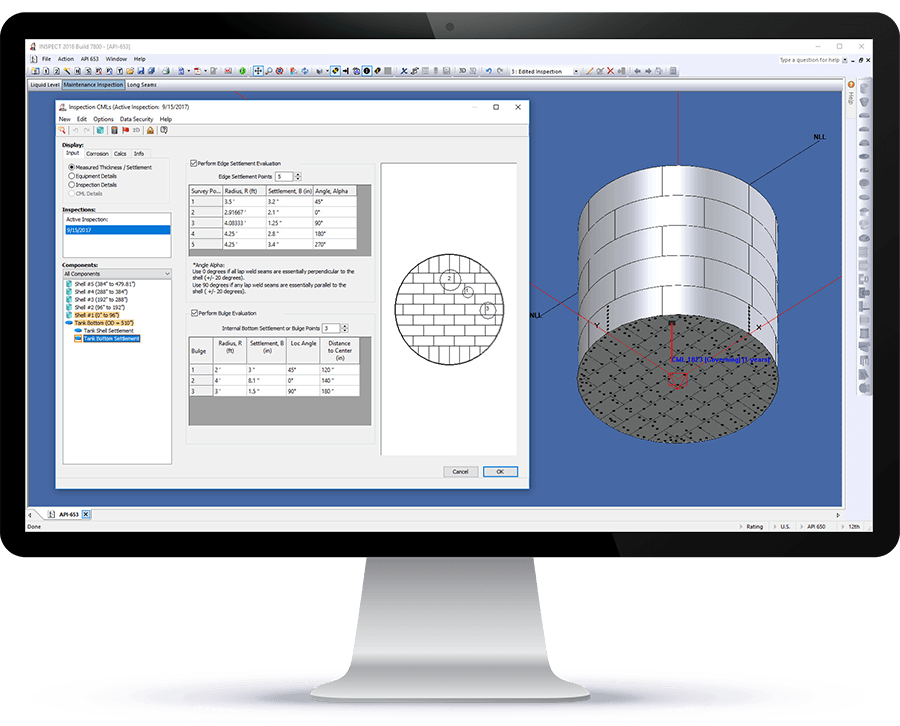
INSPECT Includes API 653 Storage Tank Evaluations, Inspection Data Management and Reports

ASME VIII, API 510, API 570, and API 653

INSPECT’s mechanical integrity capabilities include a flexible inspection data management system that lets you specify the CML data to track.  Rigorous tmin, remaining life, and inspection interval calculations are built-in. All API 510 and API 570 Code results are supported by full ASME VIII (both Division 1 and Division 2), ASME B31.3, ASME B31.4, and TEMA calculations and reports.  Old ASME VIII-1 Codes, dating back to 1950, are supported.  INSPECT helps safely extend equipment life and inspection intervals by implementing the most economical Code allowable stresses and weld joint efficiencies permitted by the NBIC / API 510. API 653 storage tank assessments include consideration of shell out-of-plane and edge settlements, floor bulges, and patch plates.
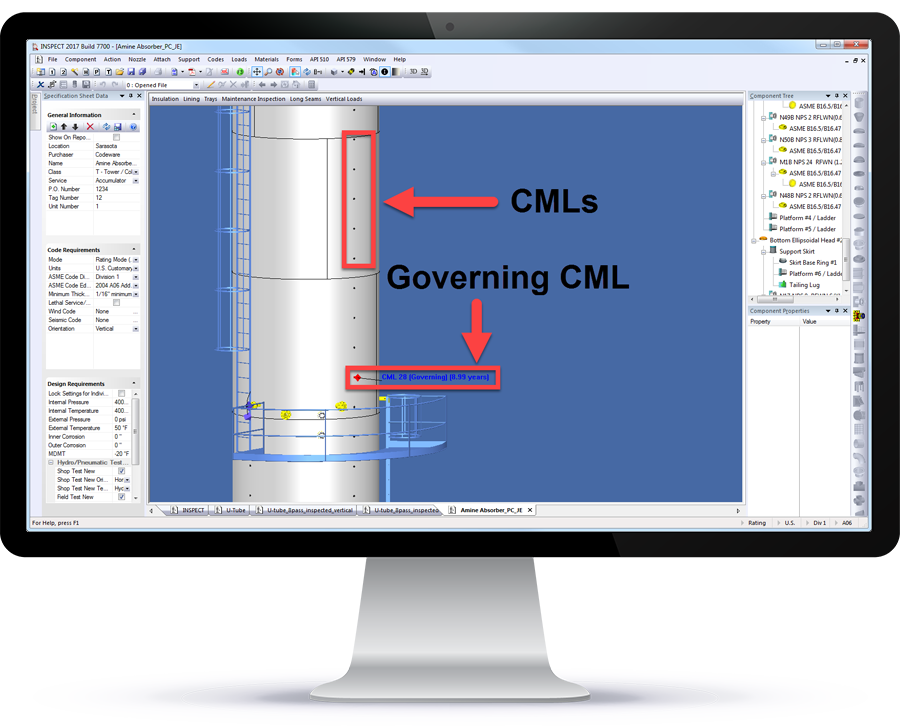
Unlike competing FFS software, INSPECT shows the governing CML on the equipment 3D model

Pressure Vessel Re-Rating With INSPECT

  • INSPECT quickly performs ASME compliant pressure vessel re-rating calculations and includes support for ASME Codes dating back to 1950.

  • INSPECT accurately determines what equipment re-rating does to equipment remaining life and inspection schedules.

  • Unlike other mechanical integrity systems, INSPECT produces extensive audit trail reports that document all calculations performed.